PuzzleGen
Generates original chess puzzles with reinforcement learning, rewarding uniqueness, counter-intuitiveness, and novelty. Evaluated by chess grandmasters and featured on lichess and chess.com.


Generative models are good at reproducing what they have seen, but genuinely creative, counter-intuitive output is much harder. Chess puzzles are an ideal test bed: strong players recognise beauty instantly, yet the elements that make a position surprising and elegant are hard to pin down.
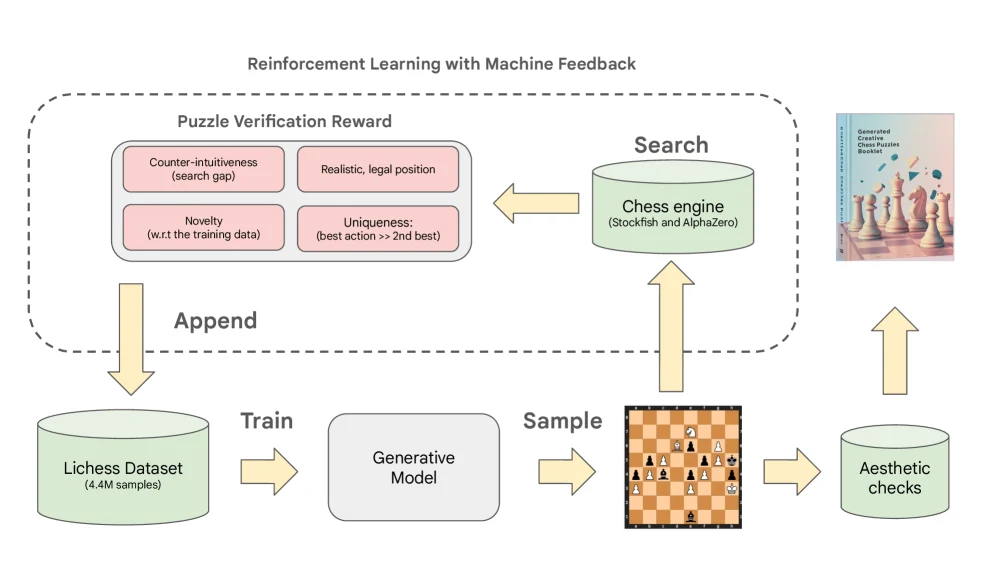
PuzzleGen starts from a generative model trained on 4.4M Lichess puzzles, then applies reinforcement learning with rewards computed from chess-engine search statistics. Rather than optimising for difficulty, the rewards target the things that make a puzzle good: uniqueness, counter-intuitiveness, novelty, and realism. The result increases counter-intuitive puzzle generation roughly 10×— from 0.22% for the supervised model to 2.5% — beating both the training data’s own rate (2.1%) and the best Lichess-trained baseline (0.4%).
How it works
Each position the model samples is handed to a chess engine (Stockfish and AlphaZero), which scores it against four verification rewards. High- scoring puzzles are appended back into training, so the model keeps learning to produce more of them — a reinforcement-learning loop with machine feedback.
The rewards
The design of the reward is the heart of the method. Each is derived from engine search statistics rather than hand-authored heuristics:
Counter-intuitiveness — the search gap
Rewards positions whose winning move looks bad to a shallow search but is clearly best under deep search. That gap between first impression and truth is what makes a move surprising.
Uniqueness — best move ≫ second best
A real puzzle has one solution. Using Stockfish search statistics, we reward positions where the top move dominates every alternative, so the answer is unambiguous.
Novelty — w.r.t. the training data
The position should be genuinely new — not a near-duplicate of something already in the 4.4M-puzzle Lichess training set the model learned from.
Realism — a legal, natural position
The board must be legal and look like it could have arisen from a real game, rather than a contrived arrangement of pieces.
What the grandmasters said
Three world-renowned experts — all noted authors on chess aesthetics — reviewed the generated booklet and explained what made their favourites appealing.
“A valuable chess puzzle should be original and creative, with a surprising, counter-intuitive key move and a smart follow-up. The ideal puzzle is also aesthetically pleasing and offers a satisfying, flowing solution.”
“I favor natural positions resulting from reasonable play by both sides. Puzzles lose my interest if one side's pieces are clearly misplaced, or if a complex solution yields a minimal advantage.”
“AI is now capable of generating interesting chess positions, beyond just “mining” databases. The positions in this booklet represent a pioneering step in this human–AI partnership.”
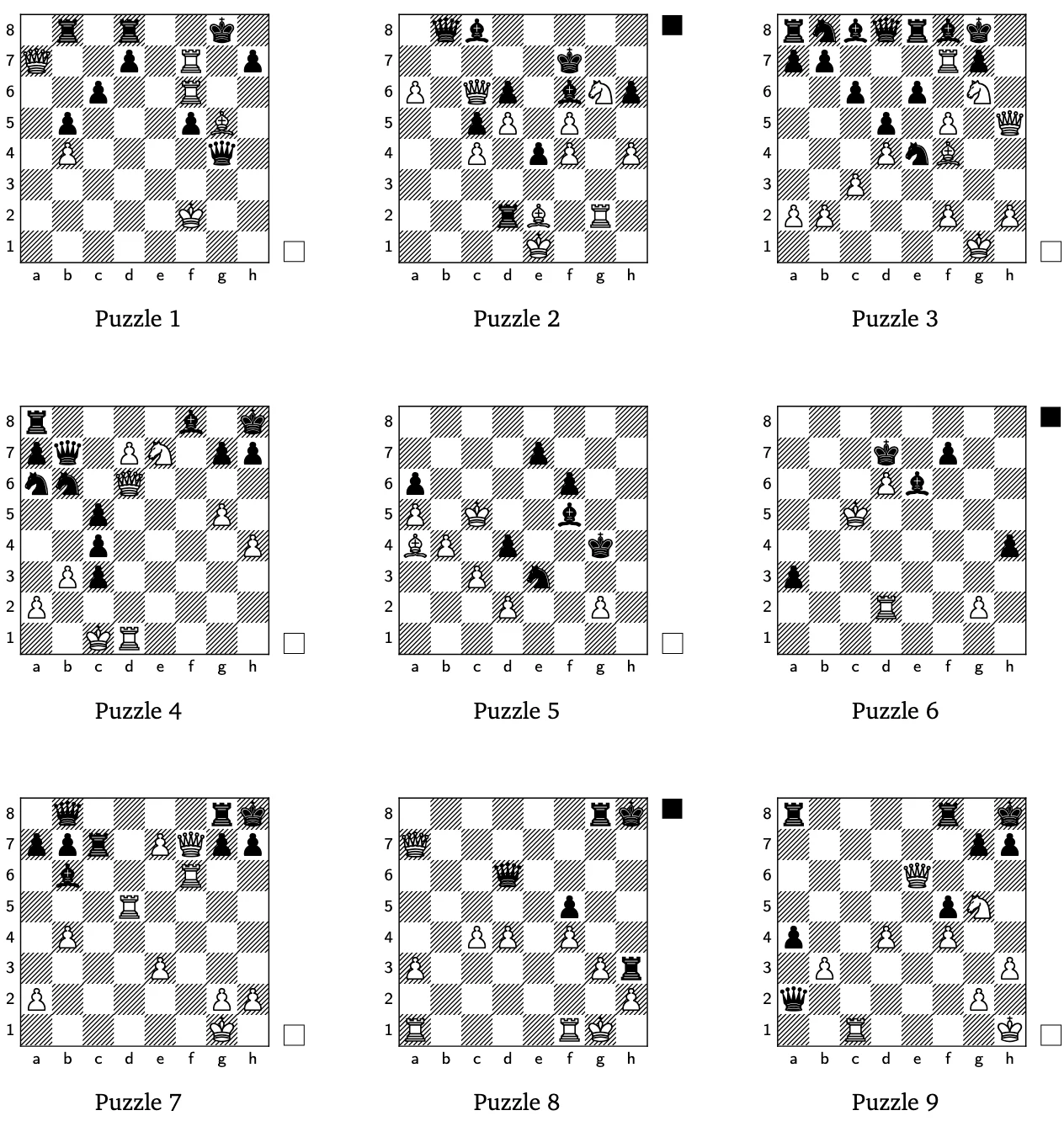
All three independently singled out one position as beautiful — its key move, a rook sacrifice, was described as “unorthodox” and “by no means a natural or obvious sacrifice.” It’s Puzzle 1 in the board below.
Try the puzzles
Nine of the generated positions — drag the pieces to play out your line. Open any one on Lichess for the full analysis board, or browse the whole set on chess.com.
Watch
Papers
- X. Feng, V. Veeriah, … T. Zahavy. Generating Creative Chess Puzzles. NeurIPS 2025. arXiv:2510.23881.
- V. Veeriah, F. Barbero, … T. Zahavy. Evaluating In Silico Creativity: An Expert Review of AI Chess Compositions. 2025. arXiv:2510.23772.